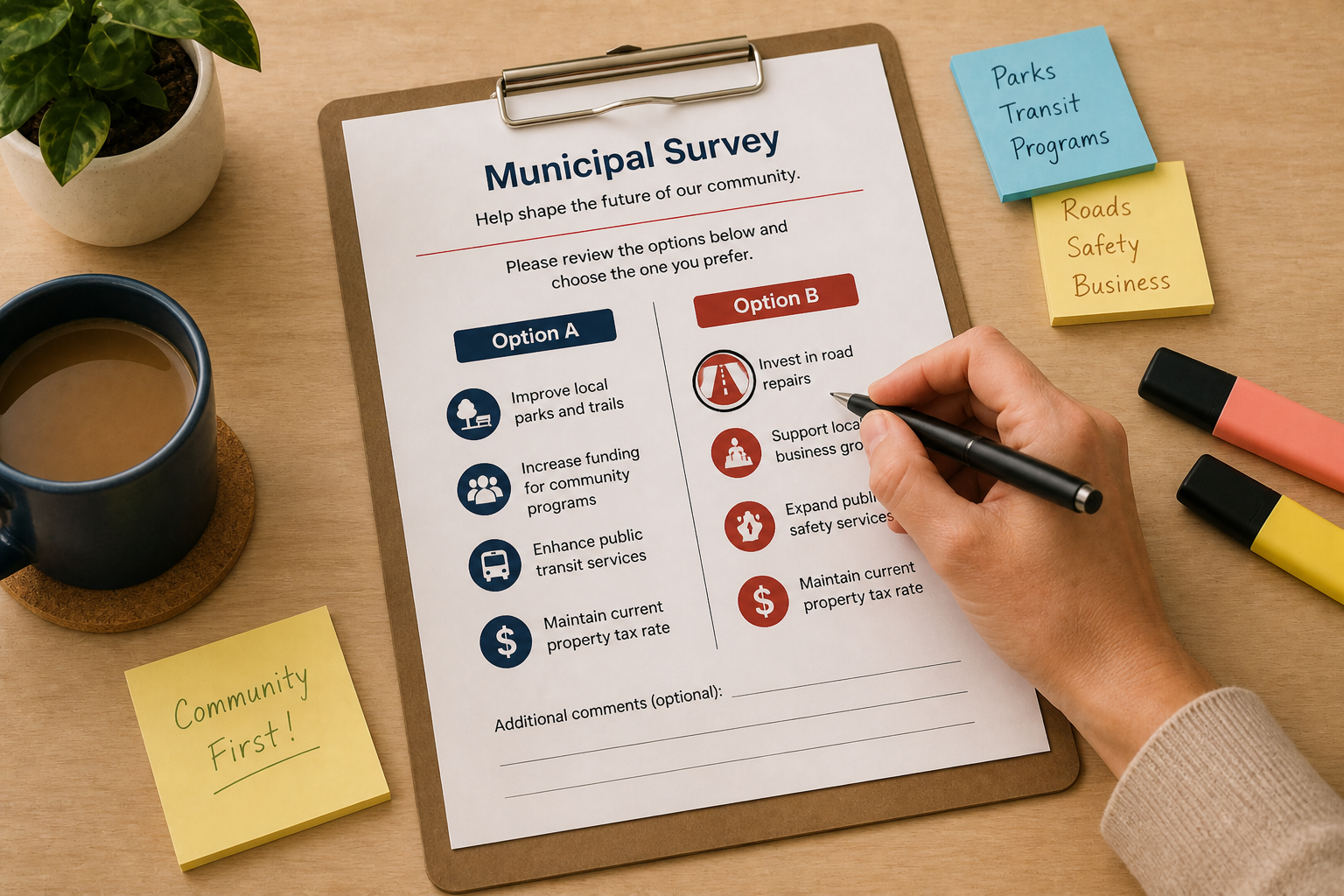
Writing Task 2 presents two options — often a workplace policy, community plan, or survey choice. You must pick one side and support it; sitting on the fence costs points.
The highest-scoring responses follow a clear four-paragraph structure with a decisive opinion and distinct reasons backed by examples.
Four-Paragraph Framework
Paragraph 1 — Introduction: state your choice and preview two reasons.
Paragraph 2 — Reason 1: explain the first benefit with a specific example.
Paragraph 3 — Reason 2: add a different angle — cost, wellbeing, productivity, fairness.
Paragraph 4 — Conclusion: restate your choice and end with a forward-looking sentence.
Introduction That Scores
Open with context: Having reviewed the proposed changes to our neighbourhood library hours, I support the weekend extension plan.
Add a roadmap: Longer Saturday access would help working families and students without adding weekday staffing pressure.
Paraphrase the prompt in your own words — raters want to see you understand the scenario, not repeat it mechanically.
Developing Reasons Without Repetition
Each body paragraph needs one main idea only. Reason 1 might focus on employee productivity; Reason 2 on recruitment and retention.
Use connectors: First, Additionally, As a result, For instance. Examples can be brief — a team that meets twice weekly in person, or a parent who saves commute time.
Common Task 2 Mistakes
Listing both sides equally without choosing — raters treat this as incomplete task achievement.
Repeating the same reason in different words — you need two genuinely different supports.
Running out of time before a conclusion — always reserve 3 minutes to wrap up.
Quick Outline Before You Type
Minute 1: underline action words in the prompt and circle Option A or B.
Minute 2: jot Reason 1 + example, Reason 2 + example.
Minutes 3–22: write. Minutes 23–27: proofread tenses and word choice.
Practise this outline until it takes under two minutes — speed in planning creates space for better vocabulary in the draft.