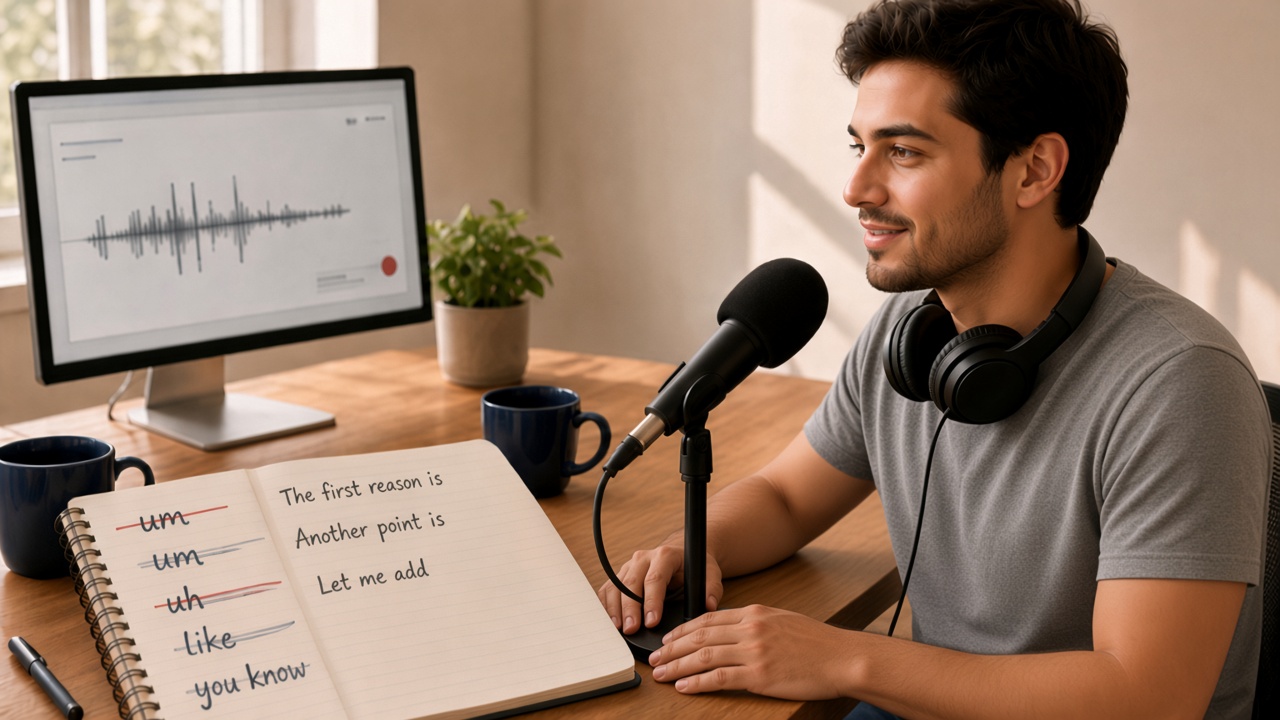
CELPIP Speaking is recorded through a microphone. There is no examiner nodding along, and there is no second take. Every um, uh, like, and you know is part of the clip a rater hears.
Filler words are not a character flaw. They are a habit that shows up when you are translating, stalling for an idea, or afraid of silence. On a timed speaking test they cost you two things at once: seconds you need for content, and the impression that your speech is steady.
This guide is original PrepHero practice advice. It is not a copy of an official scoring guide, and it does not use official test questions. Confirm current task timings on celpip.ca before test day.
What counts as a filler on CELPIP Speaking
A filler is a sound or phrase you drop in while you search for the next idea. The usual ones in English are um, uh, like, you know, so, basically, kind of, and I mean. Some speakers also stretch a word — soooo, actuallyyyy — which does the same job.
A short, quiet pause is different. One beat of silence while you breathe is easier to listen to than three ums in a row. Raters are listening for speech that moves forward. They are not expecting a radio host who never stops.
- Sounds: um, uh, er, ah.
- Habit words: like, you know, so, basically, kind of, I mean.
- Stalling questions: How can I say this? What is the word?
- Better: a one-second pause, then a linking phrase you already planned.
Why fillers spike on this exam
Prep time on CELPIP Speaking is short — often about 30 seconds, sometimes about 60, depending on the task. If you spend that window worrying instead of outlining, you start the recording with no map. Fillers then appear every time you hit a gap.
Many test-takers also translate from another language in real time. That extra step creates holes. The microphone records the holes as um.
A third cause is perfectionism. You hunt for a precise word, stall, and lose the sentence. A simpler word spoken cleanly is stronger than a rare word wrapped in hesitation. For word choice that still sounds natural, see CELPIP vocabulary for CLB 9.
Use every second of prep time
Do not write a script. You will not finish it, and reading it aloud sounds stiff. Write three short cues: your opening line, two reasons or details, and a closing line.
For giving advice, that can be: situation → my advice → reason one → reason two → wrap-up. For a personal story: when / what happened / how it ended. For a picture task: centre of the scene, then left, then right.
Those cues are what you reach for instead of um. If you want ready-made rails for the first four tasks, use CELPIP Speaking practice for Tasks 1 to 4.
Replace fillers with planned linking phrases
Linking phrases buy you a moment without sounding stuck. Practise them until they are automatic, then drop one in when you need a breath.
- To start: The first reason is … What stands out first is …
- To add: Another point is … On top of that … Let me add …
- To give an example: For instance … A good example is …
- To close: That is why I would … Overall, I think …
Train the pause, not the panic
When you feel a filler coming, close your mouth and inhale through your nose. Then say the next cue from your outline. The silence will feel long to you. On the recording it usually sounds like a natural break.
If you lose a word, skip it. Say a simpler one: the large store instead of the exact chain name you cannot remember. Keep the clock moving. Stopping to apologize — sorry, um, wait — costs more than the missing word.
Speak at a conversational pace. Rushing creates more errors, which creates more fillers. Finishing a few seconds early with a clear wrap-up is better than racing and stalling at the end.
A one-week drill that actually cuts fillers
Record the same task type each day for seven days. After each take, play the clip once and tally um, uh, like, and you know. Write the number at the top of your notes. Do not judge the first score. Watch the number fall.
- Day 1–2: record two advice tasks. Count fillers. Note where they cluster — usually before a reason or an example.
- Day 3–4: record two stories or picture descriptions. Practise a one-second pause instead of um.
- Day 5–6: record under the official prep time only. No extra thinking after the beep.
- Day 7: redo your weakest prompt. Aim for fewer fillers, not a perfect accent.
Stay natural while you clean up the speech
Fluency is not speed and it is not a memorized paragraph. A CLB 9-style answer sounds organized, specific, and easy to follow. Contractions are fine. A warm tone is fine. What you want to lose is the noise between ideas.
If you strip out every like and then freeze, you have only moved the problem. Keep the linking phrases, keep the outline, and keep talking until the timer ends. One corrected stumble is normal. A string of fillers in every sentence is the habit to break.
PrepHero CELPIP is independent practice. It is not affiliated with Paragon Testing Enterprises. A practice recording is not an official result. For the full skill order on test day — Listening, Reading, Writing, then Speaking — see the CELPIP exam pattern.