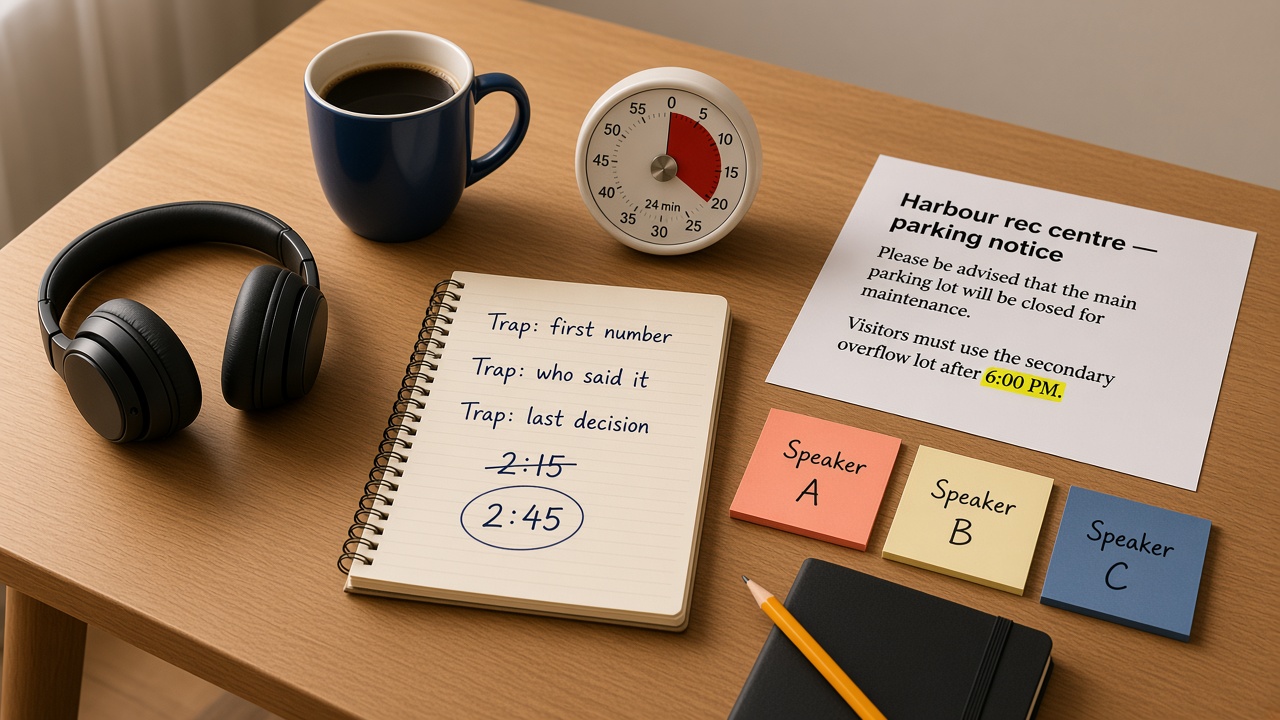
On CELPIP Listening you hear each clip once. The options are written to look reasonable. The trap is rarely a nonsense answer. It is a detail that was true for five seconds, then replaced.
If you circle the first time, the first location, or the first speaker you notice, you will often match a distractor. The skill is to track the final decision, who owns it, and what the question actually asks.
The examples below are original PrepHero study scenes. They are not official test items and they are not copied from other courses. Confirm part names and timing on celpip.ca. For the full session order — Listening, Reading, Writing, and Speaking — see the CELPIP exam pattern.
Trap 1: the first plan that gets changed
Everyday conversations often start with a booking, a time, or a place, then someone calls back and changes it. The recording still mentions the old plan, so it appears in an option.
PrepHero example: a clerk first offers a textbook pickup at the Millbrook branch on Thursday. After a second call, the hold is moved to Stonehaven for Saturday morning. The question asks where the student should go. Thursday and Millbrook are both in the audio. Saturday at Stonehaven is the answer.
In your notes, do not stack every idea as equal. Draw a line through the first plan when it is cancelled. Circle only the last agreement.
Trap 2: the first number
Times, fees, room numbers, and measurements show up more than once. The first figure is often a quote, a guess, or a cutoff that later changes.
PrepHero example: a dental desk says the stitch removal is at 2:15. Later the clerk adds that arrival after 2:25 means the slot is released. A question about the latest safe arrival is 2:25, not 2:15. A question about the appointment itself is still 2:15. Read the question stem before you pick the number you remember most clearly.
Write numbers with a short label: appt 2:15 / cutoff 2:25. Labels stop you from mixing the two under time pressure.
Trap 3: who said what
This trap is sharpest when three people talk, which is the usual shape of a discussion part. Two speakers may agree. One may object. A question that asks who is against the idea will use a line that someone else only repeated.
PrepHero example: on a rec-centre committee, Amrita wants Saturday yoga in the gym. Cole wants it in the smaller studio. The chair, Noor, says the gym is already booked for a tournament and the studio is the only option. If the question asks who blocked the gym, the answer is Noor, even though Cole preferred the studio.
On your page, keep three short columns or sticky labels — A, B, C — and jot one verb each time a person decides something: wants, rejects, books. Do not write full sentences.
Trap 4: the word you heard, not the meaning
Options often reuse a rare word from the clip. That makes the option feel familiar even when the meaning is wrong.
PrepHero example: a hardware clerk says the customer should not buy eggshell for a kitchen, and should take semi-gloss in sage instead. An option that says eggshell for the kitchen uses a word you heard. It is still wrong.
When two options share a keyword, go back to your note about the correction: not X, Y. The word after not is usually the distractor.
Trap 5: writing too much and missing the next line
You cannot pause the audio. If you copy a sentence in full, the next fact — often the one the question needs — is already gone.
Use abbreviations you can read later: Thu, Sat, rec, vis lot, $60, ID. Draw an arrow when a plan changes. Leave blank space between parts so Part 4 notes do not collide with Part 5.
If you miss a line, put a question mark and look up. Guessing from the next ten seconds is better than staring at a half-written word.
Trap 6: attitude versus a fact
Some questions ask why someone called, how they feel, or what they want next. A factual detail in the same clip — a price, a street, a time — will sit in an option because you heard it clearly.
PrepHero example: a tenant calls about a cracked balcony door. She mentions a $90 after-hours fee in passing, then asks the manager to send a carpenter on Tuesday morning. If the question is her main purpose, Tuesday’s carpenter is the point. The fee is background.
Before you click, reread the stem. If it says mainly, purpose, or attitude, ignore the sharpest number unless the stem asks for that number.
A compact note system you can use on every part
You do not need a new method for each of the six listening parts. One page layout is enough.
- Top of the page: names and roles as soon as you hear them.
- Left: times, prices, and places, each with a three-letter label.
- Right: who decided what. Strike through anything that is cancelled.
- After the clip: answer the easy factual items first, then the purpose and inference items while the tone is still fresh.
What to do in the seconds after the audio
The clip ends. The questions are still on the screen. This is not extra listening time — it is decision time. Do not replay the conversation in your head from the start. Start with the questions you already marked in notes.
Eliminate options that match a cancelled plan. Eliminate options that attach a fact to the wrong speaker. If two options remain, pick the one that matches the last decision, not the first mention.
Then let the item go. A long argument with yourself on question three can cost you question seven. For stamina across the whole sitting, pair this with essential CELPIP exam tips.